The carve-up of a $103 billion GST funding pool for 2026-27 for states and territories has been announced with Queensland and NSW already unhappy.
The Commonwealth Grants Commission (CGC) says that in 2026–27, all middle tier governments should receive more GST funding compared to the year before due mainly to greater revenue.
CGC chairman Mike Callaghan explains that a state’s share of GST funding changes from year to year.
“Key drivers of changes in state GST shares in 2026–27 include the value of mining production declining, large COVID-19-related health and business support expenses no longer being assessed, and the strength of property markets changing across Australia,” he says.
“Given the volatility in state economic and social circumstances, a change in a state’s GST share in 2026–27 cannot be assumed to continue in future years.”
The GST pool comprises of a fixed amount each year; for a state to receive more GST funding, one or more states must receive less.
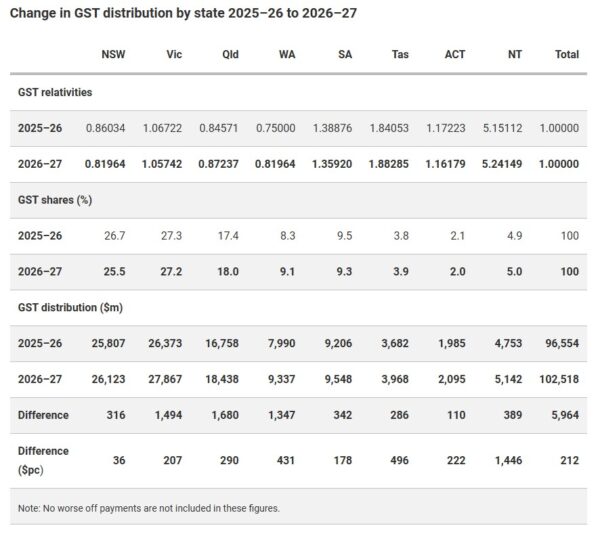
GST payment breakdown for 2026-27:
Queensland stands to receive the biggest increase in funding, up an extra $1.7bn to $18.4bn, driven by falling coal prices reducing royalty revenue, a fall in COVID-19 spending and lower NSW disaster relief spending.
Western Australia remains the fiscally strongest state based on its iron ore royalties; it will get $9.3bn as iron ore prices fall.
NSW gets $26.1bn, a 1.2% fall in GST share, driven by lower spending on disaster relief than previously estimated and higher land values fuelling more land tax revenue than in other states.
Victoria’s share falls very slightly to $27.9bn given that Qld and WA’s falling coal and iron ore prices saw them attract more GST funding.
South Australia will get $9.5bn, another small fall as it can raise more stamp duty revenue.
Tasmania will get $3.9bn, a slight rise due to greater spending on hospitals and regional policing.
The ACT will get $2.1bn, a slight fall due to its growing population and ability to pay its debts.
The Northern Territory will get $5.1bn, a slight increase due to greater spending needs for First Nations people and health services, and on schools.
Click here for a more detailed guide
NSW REACTS
The NSW Government says its share of the GST pool will have fallen by four cents to 82 cents in the dollar for the next financial year compared to 92.4 cents in 2024.
Acting Treasurer Courtney Houssos claims “a fairer” allocation of GST funding is needed.
“Successive NSW governments identified the need for reform. We will continue to engage with the Commonwealth and work towards a more transparent system which can deliver NSW our fair share,” she says.
“Having inherited a record deficit from the previous government, we are working hard to improve the state’s fiscal position so it can withstand external shocks.
“We will maintain our fiscally disciplined and prudent approach as we continue to invest in the schools, hospitals and essential public services.”
QUEENSLAND’S DISMAY
Queensland has been short-changed by Canberra, claims (Coalition) state treasurer David Janetzki.
“Despite having the highest net interstate migration, most decentralised population, increasing demands for essential services and being a growing driver in the national economy, our share is growing less than elsewhere,” he says.
“States should not be penalised for their continued contribution to industries that drive national wealth yet under the existing GST distribution methodology, that’s what’s happening.
“The federal 2026 Productivity Commission inquiry is an opportunity to restore fairness to Australia’s system of horizontal fiscal equalisation; we’re calling on the Albanese Government to restore our fair share of GST.”