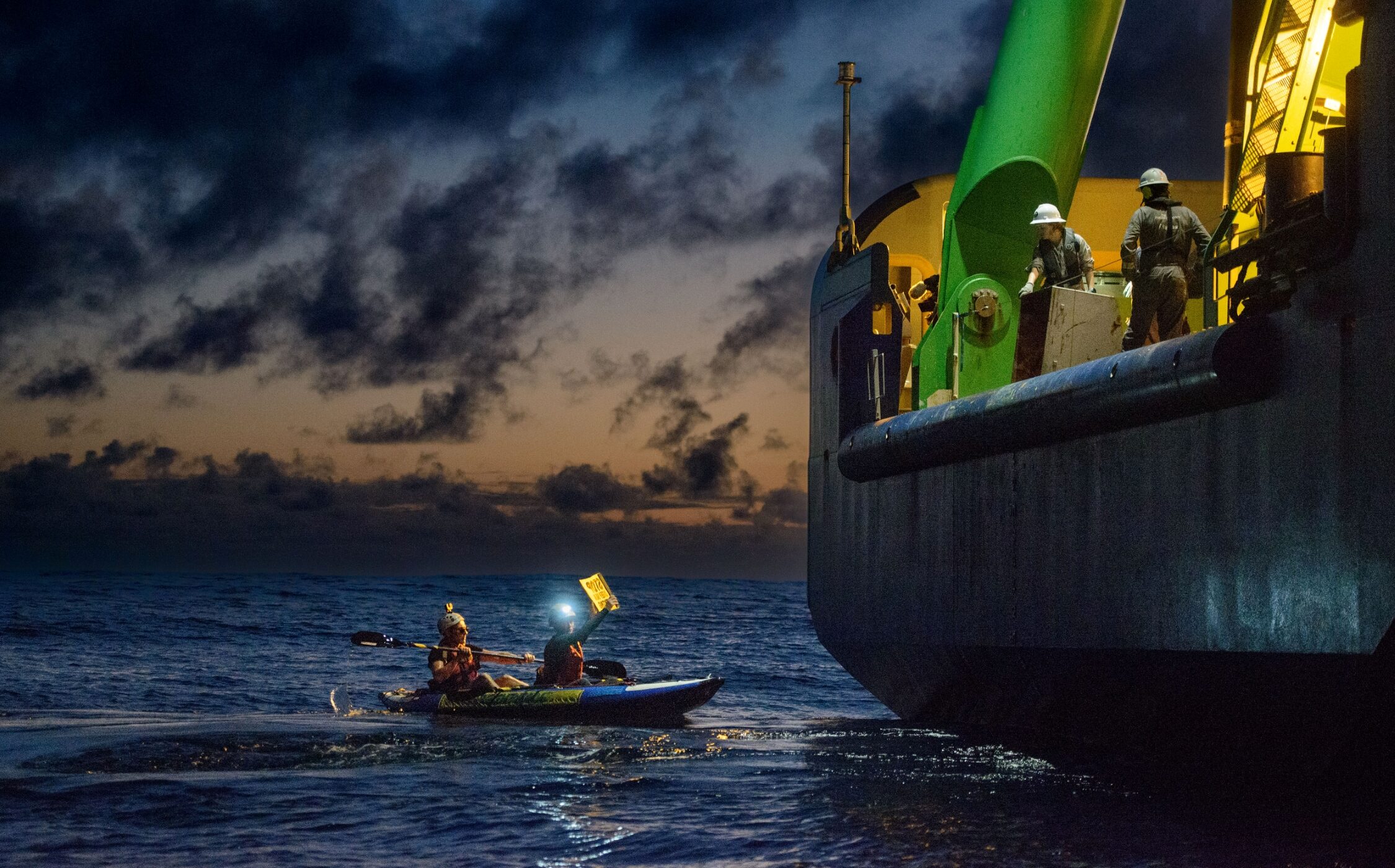
Pacific Island states are likely to miss out on the financial benefits of deep-sea mining in their territorial waters, Greenpeace International says.
New independent research commissioned by the environmentalists say Pacific Islands would likely become one of the most affected, but worst-off, beneficiaries in the world if the industry goes ahead.
Head of Pacific at Greenpeace Australia Pacific, Shiva Gounden says that what the Pacific is being promised “amounts to little more than scraps”.
“The people of the Pacific would sacrifice the most and receive the least if deep sea mining goes ahead,” he says.
“We are being asked to trade in our spiritual and cultural connection to our oceans, and risk our livelihoods and food sources, for almost nothing in return.”
He says the Pacific will simply “not benefit from deep sea mining”.
“Our sacrifice is too big to allow it to go ahead. The Pacific Ocean is not a commodity and it is not for sale.”
PACIFIC ‘TO MISS OUT’
Research author and legal professor Dr Harvey Mpoto Bombaka and development economist Dr Ben Tippet warns that revenue-sharing mechanisms proposed by the International Seabed Authority (ISA) would leave developing nations with meagre payments.
(Click here to learn more about ISA)
They say Pacific Island nations would receive only A$64,400 a year in the short term and A$337,800 annually in the medium term, increasing over time to average out to A$535,450 a year over 28 years.
They point out that this last figure is less than some individual CEO salaries; mining companies could rake in over A$18.9 billion annually and take up to 98% of revenue.
Dr Bombaka of the Centro Universitário de Brasilia in Brazil says that a proposal described as global benefit-sharing “increasingly looks like a framework … that would deliver almost no real benefits to anyone other than the deep sea mining industry”.
“The structural limitations of the proposed mechanism would offer little more than symbolic returns to the rest of the world particularly developing countries lacking technological and financial capacity.”
The analysis shows that in a scenario where six deep sea mining sites begin operating in the early 2030s, the revenues for Island states would be “extraordinarily small” in contravention of the United Nations Convention on the Law of the Sea (UNCLOS).
The researchers studied ISA proposals 2022 to 2025 to conclude that the financial returns to states would be minimal and would diminish further after administrative costs, institutional expenses and compensation funds are deducted.
“The only equitable path is to leave the minerals where they are and stop deep sea mining before it starts,” Gounden says.
“Clearly, deep sea mining will not benefit the Pacific, and the only sensible way forward is a moratorium.”
The ISA is due to meet in March for the first time this year; currently, 40 countries back a moratorium or precautionary pause on deep sea mining.
EARLIER MARITIME NEWS: UN finishes high seas treaty