
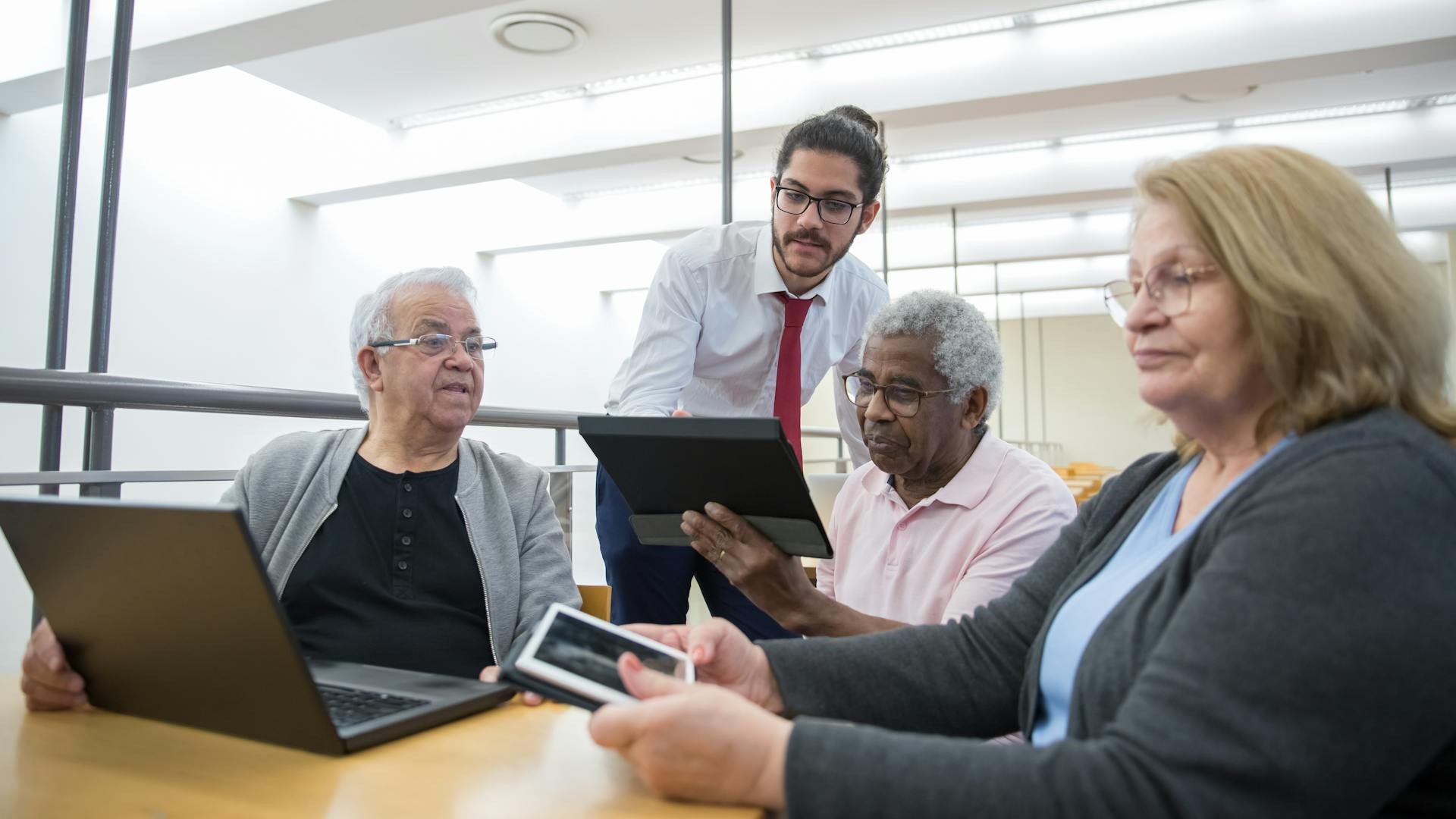
A lack of digital skills means one in four Australians face exclusion from society amid a continual shift of services online.
And this divide is throwing up barriers to belonging and wellbeing for many, says Sydney sociologist Dr Ash Watson.
A rapid growth in online services from banking, government services and news to job or housing applications is making life easier for some but not others, she says.
Dr Watson is a member of UNSW Sydney’s Faculty of Arts, Design & Architecture who studies the social and cultural impacts of digital technologies.
She says national data from the 2023 Australian Digital Inclusion Index shows that 23.6% of the population is excluded or highly excluded from daily life because they lack the skills to operate online.
“Nearly one in four Australians face digital exclusion,” Dr Watson says.
“This means almost 6 million Australians have difficulty accessing the internet; this spans physical access, affording the internet and being confident and capable with their own abilities.
“The big consequence is that people can struggle to fully participate and feel that they don’t belong in Australian society as a result.”

THE DIGITAL DIVIDE
Dr Watson highlights three main reasons why people are left behind: cost, access and ability.
“It is very costly to keep up with what have become the basic digital technologies that people are assumed to have access to these days,”’ she says.
“Things like an internet connection at home with good data allowances and personal devices like smartphones are expensive and not everyone can afford to set themselves up to participate.”
Access to technology can be affected in different ways.
Physical access is a problem in rural and remote areas while urban areas also experience issues like blackspots in internet coverage.
“Something like telehealth, which is seen as a way to address the problem of distance for people who can’t easily travel or are in rural and remote areas, can’t be implemented in some areas as the internet connection isn’t strong enough,” Dr Watson points out.
“Other accessibility issues relate to how the technology is created.
“Many devices are designed first and foremost for able-bodied people who speak English so it can be harder to use digital technologies if English is not your first language, if you have vision or hearing impairments, or other difficulties in using digital technology,” says Dr Watson.
Skills and digital literacy are another challenge.
“Think about skills like typing on a keyboard or smartphone screen, searching the internet, remembering passwords and logging into accounts, and navigating a digital platform or fill in an online form. These are all essential,” Dr Watson says.
Then there’s the ability to verify online information such as news sources and scam emails.
“These issues compound. We have seen this just recently with the 3G switch off. Some people lost their physical access to this connection then struggled to afford a new smartphone that was 4G or 5G-enabled.
“Others who could afford a new smartphone struggled to use it because it was so different. Others struggled to understand the change altogether,” says Dr Watson.
A GROWING PROBLEM
Digital exclusion affects a sizeable proportion of the population, especially those who are less well off, live in rural/remote areas, have a disability, Indigenous Australians, are from non-English cultures and the elderly.
“This is not just people who are currently over the age of 65,” says Dr Watson.
“The pace of innovation means that even those of us who feel quite comfortable using technologies now can be at risk in the future as change happens really fast.”
The implications of not keeping pace with digital change are growing more significant.
“If digital technology is increasingly the ticket that gets you in the door of belonging and you can’t access that ticket, it’s clear the consequence is that people become disconnected from society,” says Dr Watson.
FIXING THAT PROBLEM
Social and digital inequality are strongly connected, explains Dr Watson.
“We need to understand how digital change and social inequity are interconnected and becoming amplified into new forms of exclusion and marginalisation,” she says.
“For example, shifts towards online work, learning, care and social life are creating new inequalities and inequities.”
Improving physical access to technology is one solution but more needs to be done, she says.
“Even though the scale of the problem is significant and pressing, great work is being done in local communities to start to address some of these issues. Public libraries, for example, are doing fantastic work around digital inclusion,” says Dr Watson.
Libraries serve as community hubs for greater social interaction, help with learning and offer access to information.
“Importantly, library resources include free access to technological facilities and support – desktop computers, internet connection, lessons on digital skills, and on-hand assistance.
“They are a place for people to access the information, help and resources they need to use digital technology and participate in society,” says Dr Watson.
“The social consequences of digital exclusion are escalating. It’s important we keep working on ways to intervene, and to change our thinking from technology first to people first when building our digital society.”
OTHER UNSW NEWS: Right-wing influences fuelling climate change distrust




