
Mitsubishi is to build three Mogami-class frigates for Australia in Japan with another eight ships to be built in Australia under a recent deal.
And New Zealand is talking to Australia about the ships as it eyes buying its own frigate (see below) to replace its combat fleet.
The first frigate is due to be delivered to Australia in 2029, the Department of Defence says; all three should be operational by 2034.
The eight other ships will be built in Western Australia as part of a $20 billion 10-year naval frigate program which is expected to create around 10,000 jobs.
The 6200-tonne general purpose frigate can be built faster, larger, is better armed and needs a smaller crew compared to Anzac frigates; it has a range of 10,000 nautical miles and armed with surface-to-air and anti-ship missiles.
It will carry a crew of 92 sailors and will carry a Naval Seahawk helicopter.
MITSUBISHI DEAL DONE
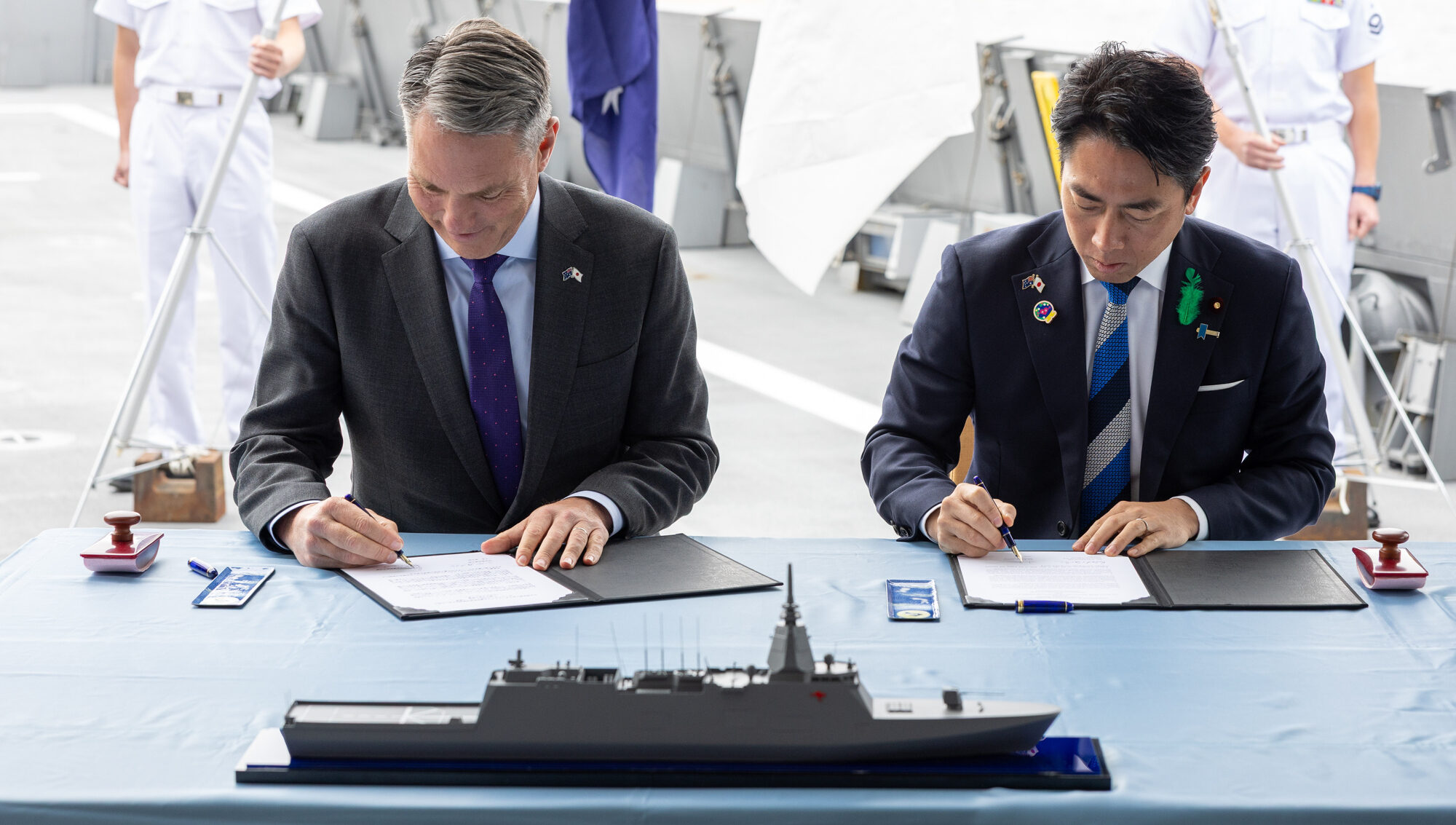
The contract was recently signed was marked by Defence Minister Richard Marles and his Japanese counterpart, Koizumi Shinjiro, in Melbourne during a bilateral defence ministerial meeting.
“Our surface fleet is more important than at any time in decades,” Marles says.
“These general-purpose frigates will help secure our maritime trade routes and northern approaches as part of a larger and more lethal surface combatant fleet.”
Defence Industry Minister Pat Conroy says the deal with Mitsubishi, and Japan, is the Navy’s fastest peacetime acquisition.
“We are working closely with Japanese and Australian industry partners as we acquire one of the most, if not the most, advanced general-purpose frigate in the world,” he says.
Australian sailors have already trained onboard a Mogami -class frigate during Exercise Kakadu recently.
(Mitsubishi has built aircraft and ship for the Japanese military dating back to before WWII, including the iconic Zero fighter and battleships).
NZ ALSO EYEING MOGAMI FRIGATE
Meanwhile, Wellington says it is eyeing Mitsubishi’s Mogami frigate to replace its aging Anzac vessels as part of its own naval fleet renewal program.
NZ Defence Minister Chris Penk said: “As a remote island nation, maritime security underpins New Zealand’s economic prosperity.”
These maritime roles include reconnaissance, combat, patrol and interception operations, transporting people and equipment and search and rescue efforts.
“These activities rely on a resilient Navy yet most ships in the fleet are expected to reach the end of their design life by the mid-2030s including the Anzac-class frigates,” he says.
Penk says a future fleet will expected to be versatile with roles including maritime combat, patrol and security, sealift, hydrography and diving operations, assistance for other government agencies, and supporting disaster relief efforts.
He says they are already talking to the Australian and British navies with interoperability with either navy a consideration for them.
“Our decision to prioritise discussions with our partners and focus on considering the Mogami frigate selected by Australia and the UK’s Type 31 frigates,” Penk says.
He says they are also examining other naval vessels suited to their needs.
A final decision is due by the end of 2027.
New Zealand’s main maritime combat vessels are the Anzac-class frigates HMNZS Te Kaha and Te Mana. It also operates an amphibious vessel, the Canterbury, and tanker Aotearoa; it lost its hydrographic vessel, the Manawanui, when it sank off Samoa last year.
The Te Kaha was called upon by Canberra to track three Chinese navy ships early last year as they circumnavigated Australia.
MORE NAVAL NEWS: Japan wins $10 billion race




