
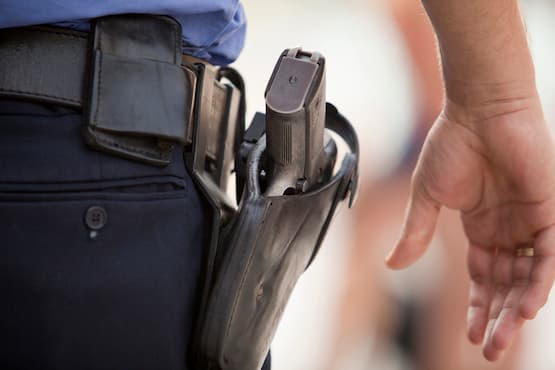
Putting guns in the hands of police officers will not lead to more shootings, new research from Monash University says.
The research investigated 50 years of officer-involved shootings in Australia between 1970 and 2020.
Lead researcher Dr Ross Hendy says the findings are crucial real-world evidence for countries that are currently debating whether their police should carry guns such as England, New Zealand, Norway and Scotland.
“The data shows that the transition to routine arming, moving from a system where officers chose when to carry a gun to a system requiring that they wear one at all times on duty, was not followed by an increase in shootings,” he says.
“In fact, after these policy changes in the early 1990s, we saw a downward trend in shooting rates.
“While the research does not suggest that routinely arming police directly caused the decrease in shootings, our findings clearly contradict the long-held view that more guns on belts inevitably lead to more people being shot,” Dr Hendy says.
“Our analysis remained consistent across multiple scientific methods: making firearms a standard part of the uniform did not lead to an increase in violence.”
GUNS USED IN SHOOTINGS TRACKED
The study, click here to read it, analysed officer-involved shootings after NSW (1991) and Victoria (1993) made guns mandatory police equipment.
Because there is no official national database for non-fatal shootings, the researchers tracked 581 shooting incidents by cross-checking decades of news archives with official coronial and police reports.
Dr Zarina Vakhitova, a Senior Lecturer in Criminology at Monash University, says the findings suggest that tactical training, not just the gun, are the main factors to consider.
“Our research suggests that arming police can be done safely if the right conditions are in place. When you combine arming with better tactical training and de-escalation protocols, it acts as a critical safeguard,” Dr Vakhitova says.
Dr Hendy notes that the Australian experience can serve as a blueprint for other jurisdictions when routine arming becomes the focus of intense debate.
“This isn’t just about whether a police officer carries a gun; it’s about the training, culture and accountability structures that surround that officer,” he says.
“When you invest in de-escalation and professional standards, the availability of a firearm does not automatically lead to its use. It is a structural and cultural issue as much as it is a policy one,” Dr Hendy said.
MORE MONASH NEWS: Tech, climate to supercharge power demand




