
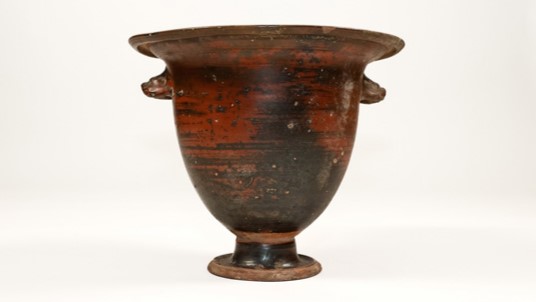
An ancient vase has been returned to Italy after Australian border officials intercepted it in transit six years ago.
The federal government says the vase from Italy’s southern region of Apulia (Puglia) dates to the 4th century BCE, making it about 2300 years-old.
The ancient vase was handed over to Italian Ambassador Nicola Lener in late June following a request from his government for its return.
Australian Border Force officials had intercepted the Apulian vase in 2020 while it was en-route from the US to New Zealand.
LEGAL RIGHT: Under the Protection of Movable Cultural Heritage Act 1986, artifacts smuggle from its country of origin can be returned to that country upon request and proof of the illegal export. The object must be protected by that country’s cultural heritage laws. Source: federal Office for the Arts
ANCIENT PIECE GOES HOME
Federal Arts Minister Tony Burke says they are “serious about protecting cultural heritage and returning objects to their rightful home”.
“This (ancient) vase tells a story from thousands of years ago and returning it honours that history,” he says.
“Thank you to everyone involved in the seizure and return of this piece of history.”
Special Envoy for the Arts Susan Templeman says the vase’s return is a sign of the government’s determination to crack down on artifact trafficking from all countries.
“We hold firm views about returning cultural objects to their country of origin and expect that the same respect is extended to us,” he says.
Mr Lener says: “The artefact returned is the first of several items identified for repatriation to Italy, underscoring the effectiveness of our shared efforts to combat the illicit trafficking of cultural property.”
ABOUT THE VASE
- The government says the vase was made between 340-325BC.
- It has a bell-shaped body and lugged handles in the shape of animal heads.
- The vase is also known as a ‘krater’, it says.
- Circular holes on the vase’s surface (known as spall marks) are caused by fragments of limestone in the clay, which slowly expand after the pot is fired and can eventually break through the surface.
OTHER ARTIFACT NEWS: Central American artifacts returned to Mexico




