
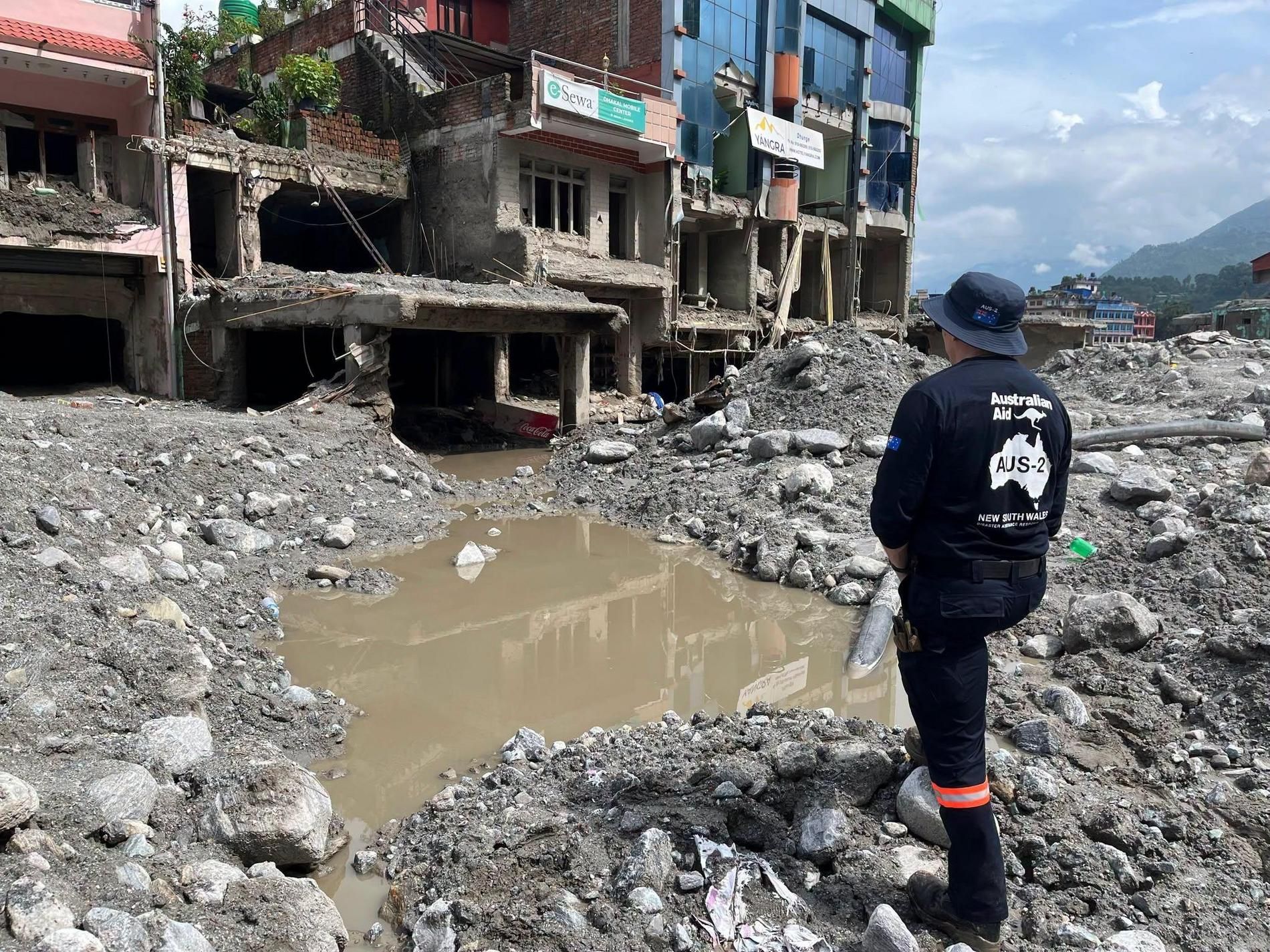
Aussie fire and rescue drone teams are now helping out in Nepal’s clean-up and recovery efforts after last month’s deadly glacial flood disaster.
At least 1367 people have died and more than 5000 missing since a Himalayan glacier broke off near the Nepal-China border in late August and flooded rivers downstream.
Click here for more about the Nepalese operations.
Foreign Affairs Minister Penny Wong says the Nepalese Government had asked for the drones and follows the deployment of 19 personnel to the former mountain kingdom; 38 Australians are reported as still missing in that country.
Australia has given $11 million to the relief effort with another $4m raised via public donations.
Fire and Rescue NSW (FRNSW) and Queensland Fire Department (QFD) drone teams are now conducting flights in some of the worst-hit flood zones.
FRNSW says it has 10 personnel with a 15-person Foreign Affairs disaster assistance response team (DART), including six drone operators, while QFD has assigned two operators.
The DART team has set up base in the town of Bidur, north-west of Kathmandu, and relaying data from their aerial missions to local emergency commanders.
AUSSIE DRONES SERVE AS EYES IN THE SKY
FRNSW says the Aussie team is operating different drone types, including small ones that can infiltrate tight spaces to look for life.
The firefighters, working with the Nepali army, have flown damage assessment flights over the Upper Trishuli hydro-power plant in Nwoko district.
The Aussie drones have captured infra-red, artificial intelligence and 3D mapping images of almost 200,000 square metres.
The drones will operate in areas considered too dangerous for ground crews to go, providing aerial reconnaissance as they assess the condition of bridges, schools and roads.
DART Commander and FRNSW Chief Superintendent Jeremy Stubbs says: “The specialist teams are using their expertise to map out the devastated areas and provide a crucial ‘eye in the sky’ alongside international crews.
“Our drones are equipped with AI software that helps us measure debris and capture footage of the damage,” he says.
“We’re then able to stream that information back to the emergency commanders to make important decisions in real time.”
Anyone wanting to make a donation can visit emergencyaction.org.au.




