
The global nuclear arsenal is not only growing but expanding as efforts to limit it fall by the wayside, says a new report from the Stockholm International Peace Research Institute (SIPRI).
The 2026 SIPRI Yearbook notes that the world’s nine nuclear-armed states — US, Russia, United Kingdom, France, China, India, Pakistan, North Korea and Israel — all modernised, and produced, weapons last year.
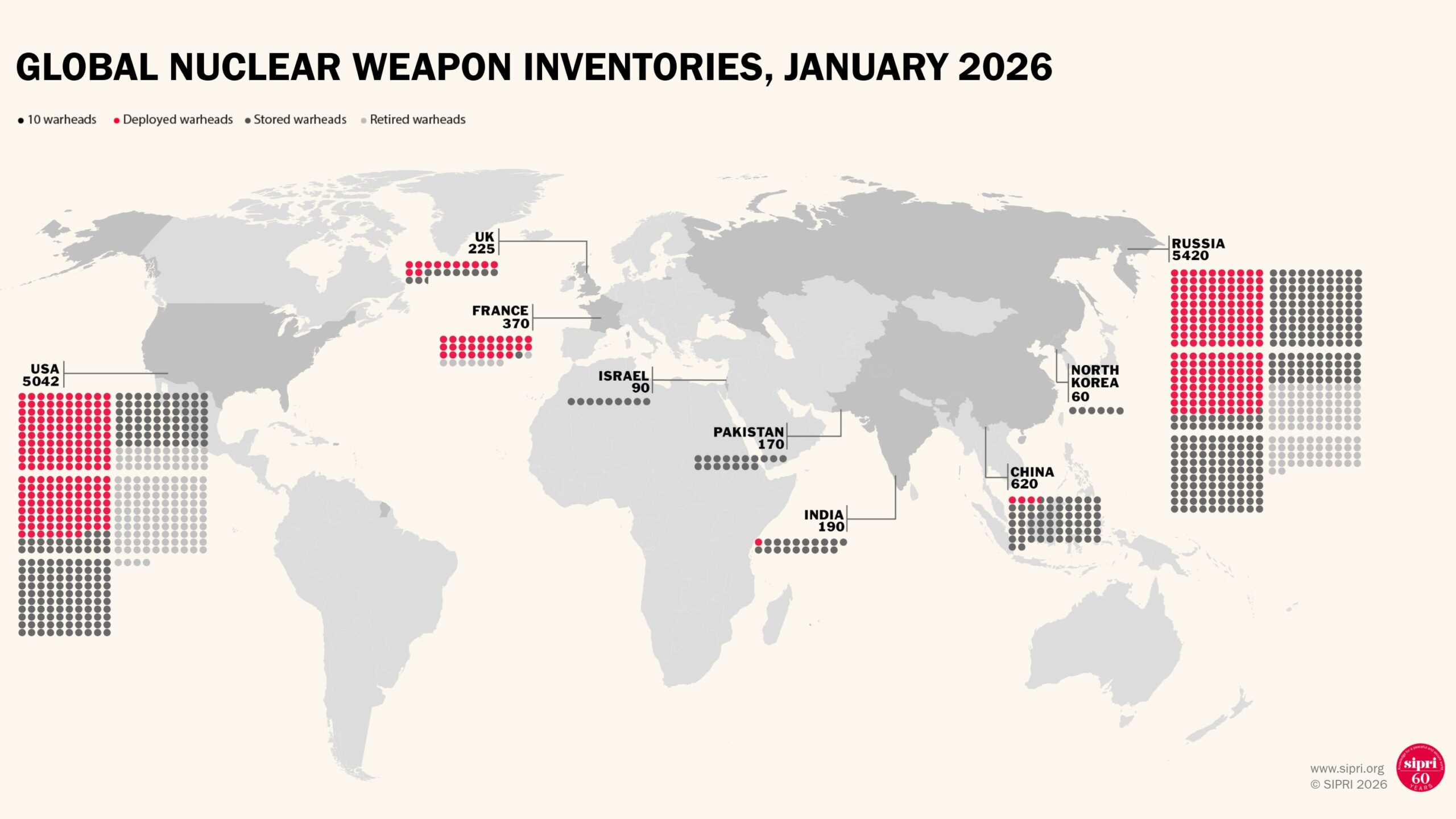
The SIPRI estimates that as of January this year, the total global inventory stood at 12,187 warheads; of these, about 9745 were in military stockpiles of which an estimated 4012 warheads were deployed in missiles and on aircraft.
About 2100-2200 of the deployed warheads in ballistic missiles were kept on high operational alert and almost all were either Russian or American.
“Influential voices, including some world leaders, are advocating nuclear weapons as a guarantee against attack by a hostile state but making national defence and security strategies dependent — or more dependent — on nuclear weapons could significantly increase risks,” says SIPRI Director Karim Haggag.
“The dangers associated with nuclear weapons are growing due to advances in weapon technology, the breakdown of arms control and heightened geopolitical tensions among other factors.
“At the same time, world events — not least the outbreak of conflict between nuclear-armed India and Pakistan — are challenging nuclear deterrence logic.”
WHO IS SIPRI? They are a Stockholm-based independent international institute that studies conflict, armaments, arms control and disarmament. Established in 1966, the institute provides data, analysis and recommendations based on open sources.
The institute notes that the post-Cold War trend of shrinking arsenals is “likely to be reversed in coming years” as dismantlement slows while the deployment of new weapons accelerates.
“The evidence is growing that the nuclear weapon states are sidelining, and even walking away from, their disarmament commitments and flexing their muscles,” says Hans Kristensen, an Associate Senior Fellow with SIPRI’s Weapons of Mass Destruction Program and a director of the Nuclear Information Project at the Federation of American Scientists (FAS).
“By reaching for nuclear solutions, states are creating new risks and fuelling arms-race dynamics.”
The institute notes that while Russia and the US together account for 83% of the global warhead stockpile, their share is shrinking as other countries expand their arsenals.
RELIANCE ON NUCLEAR WEAPONS ‘GROWS’
“Along with a reduction in transparency and the loss of diplomatic channels for crisis management, the drift towards authoritarianism in some nuclear-armed states is contributing to even greater unpredictability,” says Matt Korda, an Associate Senior Researcher with SIPRI.
“We can no longer assume that leaders operating within such systems will receive accurate data during nuclear crises nor that they will act rationally during periods of heightened tension.”
Across east Asia, Europe and the Middle East last year, debate touched on a growing desire for such weapons among non-armed states, the institute notes, naming European states like Germany and Belarus.
It also notes that these developments are happening at a time when the global non-proliferation treaties are weakening.
“The fact that the parties to the Non-Proliferation Treaty again failed to reach agreement on an outcome document is another blow to the grand bargain at the heart of the treaty: that other states will not develop their own nuclear forces if weapon states move towards disarmament” says SIPRI director Haggag.
“The absence of a successor agreement to New START, the modernisation of nuclear forces and plans to increase the deployment of weapons are all likely to further undermine the legitimacy of the Non-Proliferation Treaty.
“This will make it more difficult for the states parties to collectively address the many challenges across the nuclear landscape, including in the Middle East and East Asia.”
THE NUCLEAR NINE
- USA: in 2025, its modernisation program continued amid planning and funding challenges that are likely to further delay and significantly increase its cost. Efforts to add weapons will add more budgetary and logistical stress that will intensify due to the Trump administration’s plans for its reported $1.2 trillion Golden Dome missile defence system.
- RUSSIA: its modernisation program also faced challenges in 2025 beset by Western economic sanctions and competing demands from its war in the Ukraine; Russia is building a forward-operating base for intermediate-range ballistic missiles in Belarus, which were used in the Ukraine in May. The end of the bilateral 2010 New START treaty to reduce nuclear weapons in February has added uncertainty about the future of US and Russian nuclear force levels.
- CHINA: is estimated to have around 620 warheads compared to America’s 3700 and Russia’s 4400. China is expanding its arsenal faster than any other country. China could potentially have at least as many ICBMs as Russia or the USA by 2030, still about a quarter of the current Russian and US stockpiles.
- UNITED KINGDOM: with no expansion in 2025, its stockpile is expected to grow after a 2021 announcement to raise the ceiling on warhead numbers. Last year, the UK stopped publicising the size of its nuclear arsenal and said it would buy 12 F-35A combat aircraft armed with US bombs to join NATO’s sharing arrangements.
- FRANCE: continued to upgrade its nuclear-powered ballistic missile submarine (SSBN) force and announced plans for a new airbase in eastern France for two new Rafale aircraft squadrons equipped with next-generation hypersonic nuclear cruise missiles. In March 2026, the government stopped publicising the size of its arsenal.
- INDIA: is believed to have again expanded its arsenal in 2025 and worked on new delivery systems. Its modernisation program is increasingly focused on long-range weapons capable of reaching targets in China as well as to Pakistan.
- PAKISTAN: developed new delivery systems and accumulate fissile material in a possible precursor to expanding its arsenal over the next 10 years.
- NORTH KOREA: is believed to be expanding its arsenal with an estimated 60 warheads, enough fissile material to produce at least 30 more and accelerating the production of fissile material.
- ISRAEL: does not publicly acknowledge possessing nuclear weapons but is believed to be modernising its arsenal. In 2025, it intensified construction at a new site at the Negev Nuclear Research Centre near Dimona. Source: SPRI (click here for the article in full).




